The city the Development Corporation built
Peterborough grew faster than almost any city in England between 1970 and 1990, and it did it in townships: Bretton, then the Ortons, Werrington and Paston, each planned and built largely in one push. That matters for windows, because streets built together age together. When we survey in Bretton or Orton Goldhay, we are usually looking at a house on its first or second generation of double glazing — either the original frames from the build, now fifty years old, or an early uPVC replacement fitted in the 1990s that has itself done thirty years.
This guide is for those streets, because they are most of the city. The Victorian terraces of Millfield, Fletton and the centre are a different job, and we come to them at the end.
How to tell a township house is due
The failure pattern on township houses is consistent enough that we can often date the windows from the doorstep. The signs worth checking on your own house:
- Misted units arriving in batches
- Sealed units from the same production run fail on the same schedule. One fogged pane this year usually means two or three more within a few years — our condensation guide explains how to tell a failed unit from ordinary damp.
- Cold aluminium frames
- Plenty of 1980s replacements were early aluminium with no thermal break. The metal itself conducts the cold straight through, so the frame streams with condensation on winter mornings even when the glass is dry.
- Nineties uPVC past its best
- First-generation uPVC was a huge improvement, but the gaskets harden, the friction hinges wear, and the glazing was typically the minimum of its day. A thirty-year-old “double glazed” house can lose heat at nearly twice the rate of one glazed to current standards.
- Doors that have dropped
- Front and back doors that catch, whistle, or need a shoulder in winter. On township houses the doors usually went in with the windows and are the same age.
What a modern replacement honestly gets you
Three things, in descending order of how much people notice them. Warmth first: A-rated or better glazing against a fifty-year-old frame is not a marginal upgrade, it is a different house — the cold zone by the window disappears and the heating stops fighting the glass. Security second: the multi-point locking on a current window or composite door is a different category from the single latches and cockspur handles the townships were built with, and it is what insurance questionnaires now assume. Quiet third — with a caveat we would rather give you now than at survey. Modern sealed units take real noise out of traffic on an ordinary street, and acoustic laminated glass takes out more; but if your house backs directly onto one of the parkways, glazing softens the roar rather than deleting it. We will tell you honestly at survey which of the two your street needs.
There is also the street-by-street effect we see everywhere the housing is identical: one house on the close re-glazed in anthracite or a modern foil, with a colour-matched composite front door, and within a year we are back fitting three of its neighbours. Township houses take colour particularly well precisely because the original palette was so uniform.
The back of the house is where the townships grow
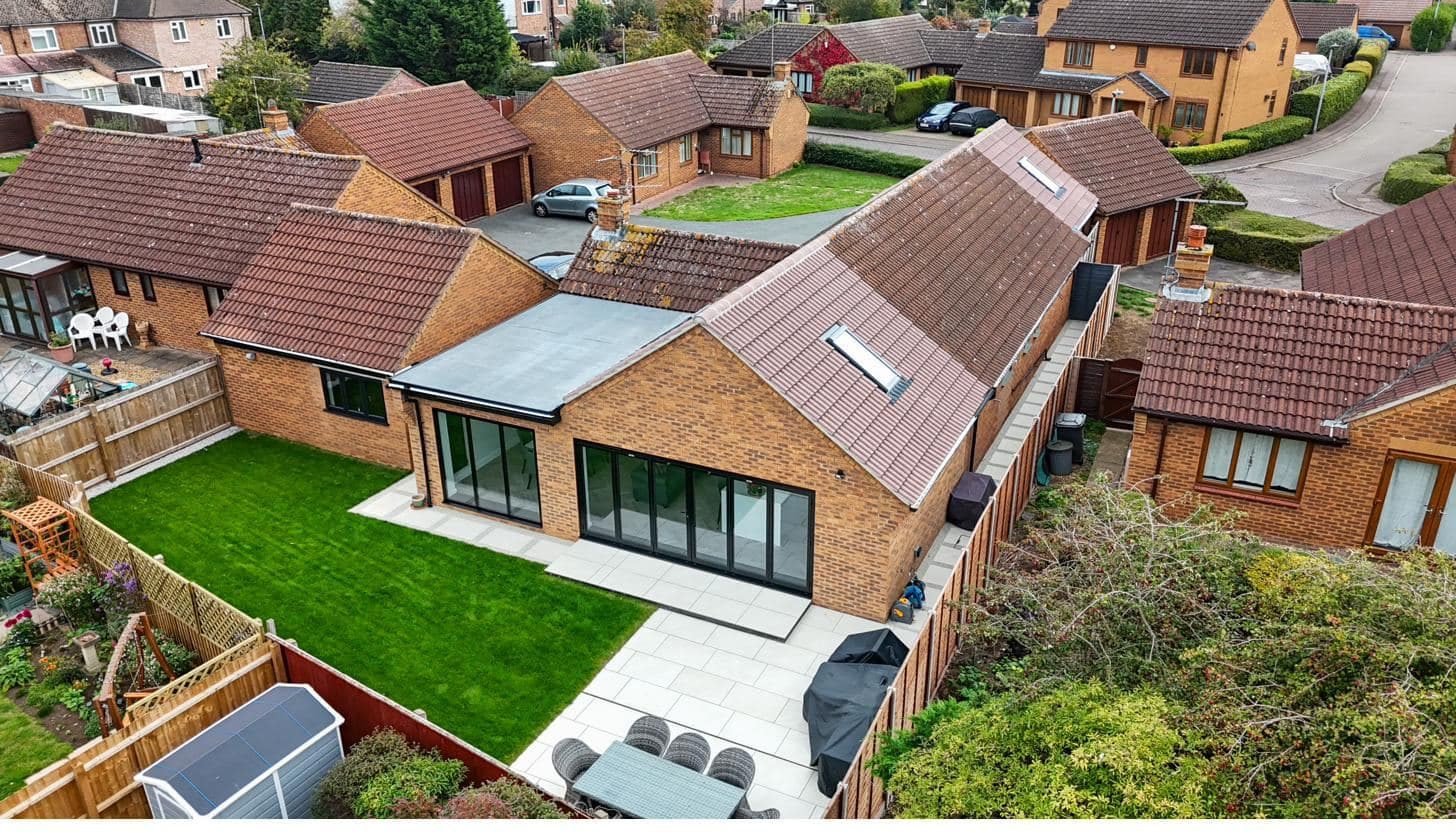
Township plots were generous by modern standards, which is why so much of our extension glazing work is in Werrington, Bretton and the Ortons — the photograph above is a Werrington rear extension we glazed with aluminium bifolds. If you are replacing windows anyway and an extension or garden room is on the five-year list, it is worth saying so at survey: matching frames, colours and sight-lines across both jobs is easy to plan up front and annoying to retrofit.
The terraces and the older city, briefly
If your house is in Millfield, New England, Fletton or the streets around the centre, the township logic does not apply — you are in Victorian and Edwardian brick, where proportions and detail decide whether a replacement looks right. Sash-look uPVC and flush casements exist precisely for these streets, and parts of the older city carry conservation designations people rarely expect; our conservation-area guide covers how to check and what gets approved.
Home turf
Peterborough is not an area we cover — it is where we are. The showroom and workshop are in Fengate, ten minutes from every township, and we fit across PE1 to PE7 with our own employed fitters and a 10-year insurance-backed guarantee on every installation. Uniquely for our Peterborough customers, you do not have to decide anything from a brochure: come and stand next to the actual windows and doors in the showroom, then book the survey when you have seen what you are comparing.
Published August 2026 · Written by the Custom Choice team, Peterborough